Fenway Sports Group: John Henry & Thomas Werner
Objective
Make money for stakeholders
Key Results

Objectives and key results (OKRs) are a goal-setting system that encourages innovation, provides focus and commitment, and motivates teams to achieve results.
OKRs can help us stay in touch with some fundamental questions:
The aim of this guide is to help us think about OKRs in the same way.
Check your understanding with the OKR quiz.
A great tool to help create focus and commitment to the right priorities.

A way of increasing transparency across the organisation and connecting peer groups.

A way of exposing redundant efforts and duplication.

An approach that empowers teams to work on the right things by making sure the overall direction is clear and aligned with the vision.

They enable and encourage teams to be open and question how the work being asked of them aligns with the strategy.

An excellent complement to Scrum and Kanban practices, helping teams understand and deliver on longer-term strategy.

A few working agreements help keep OKRs useful:
Agree how you will review and score progress. These working agreements give the team a starting point, and experience will help you improve them.
Using OKRs in a Scrum environment is a great way to help focus beyond the sprints by measuring how your increments are contributing towards the strategy.
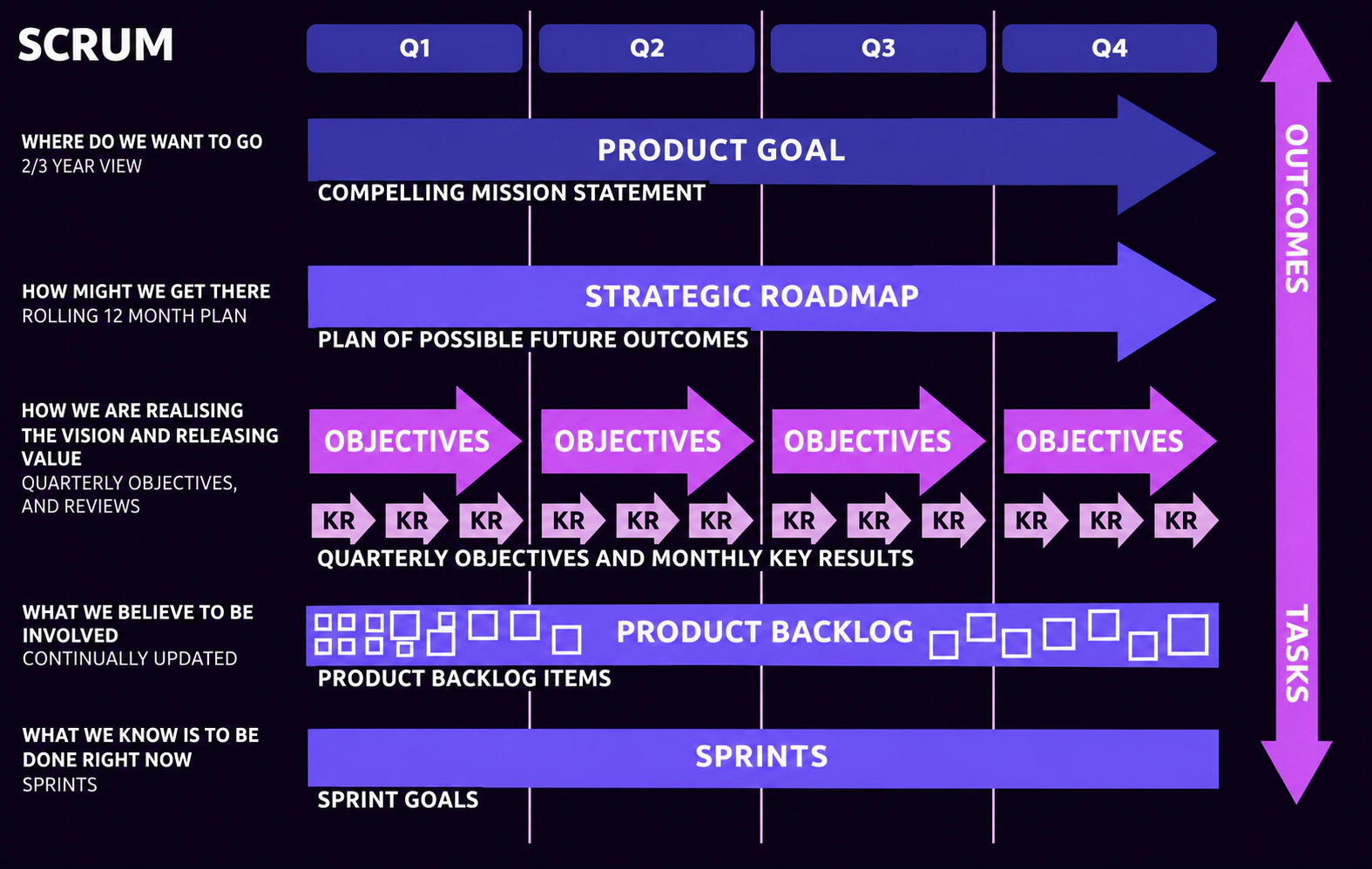
The diagram illustrates one planning rhythm, connecting the questions about direction and value to the work teams refine and deliver. The planning horizons and cadence should fit your context.
OKRs can help connect the work of the team to the overall strategic priorities.
Imposing strict rules on cascading OKRs can slow teams down, kill autonomy and create bureaucracy. Align teams around a shared direction, then give them room to decide how to contribute.
Here is a deliberately exaggerated football example to make the relationships easy to understand. Imagine Liverpool during Jürgen Klopp’s time as manager: Fenway Sports Group’s John Henry and Thomas Werner want the club to make money and win trophies. Klopp, the coaches, scouts and commercial teams each focus on how they can contribute. The objectives and measures below are illustrative.
Company
Objective
Make money for stakeholders
Key Results
Management
Objective
Win the Premier League and reach the Champions League final
Key Results
Objective
Secure TV rights and fill stands above 90%
Key Results
Teams
Objective
Increase goals per game
Key Results
Objective
No. 1 in key defensive statistics
Key Results
Objective
Hire two exciting young players
Key Results
Make money → win competitions → goals per game → Shots on target
The groups share a direction while focusing on the contribution they can make. The offensive coaches do not need to take responsibility for filling the stands.
This illustrates alignment, but the measures still need work before they become complete key results. “Shots on target” needs a target and a timeframe, with a baseline where relevant. Completing scouting visits would not, by itself, establish that the right players had been found.
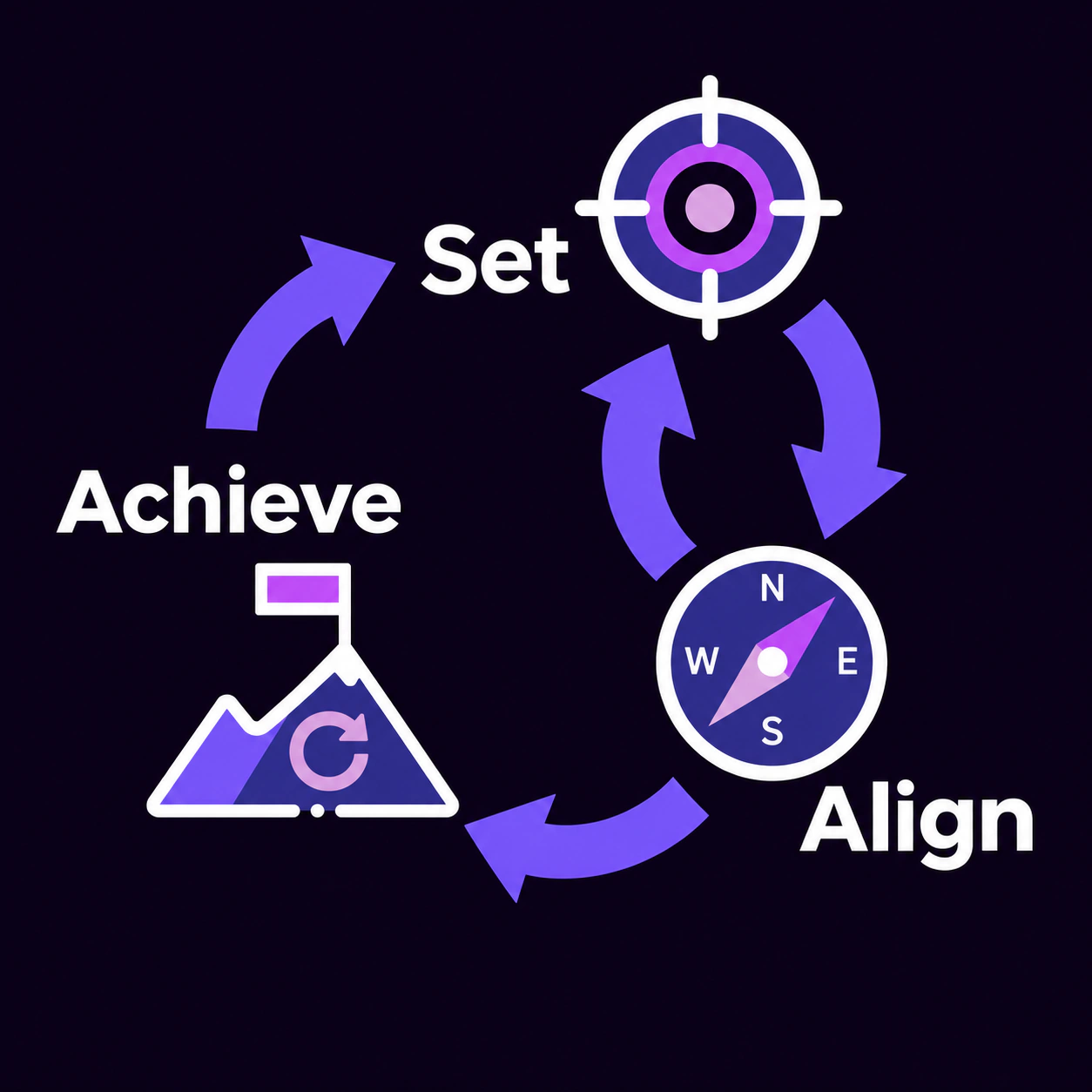
The team takes input from:
Armed with this information, the team can create one to three OKRs for the period and meet with leadership to ensure alignment.
Teams sometimes create a fourth OKR to look at business-as-usual activity, with key results that help eliminate or reduce repetitive work for the team.
The OKRs are tracked and inspected during the period. It is not a one-off setting exercise at the end of the quarter. Feedback is constantly gained and OKRs inspected.
OKRs provide focus and transparency for the team and allow discussion to take place. Rather than just doing the work that has arrived and potentially derailing existing work, the team can get together and ask:
By having transparent OKRs and something to focus on and use as a guardrail, the team can self-organise around these problems. Don’t take on too much: doing less work gets more done. Control your work in progress.
Key performance indicators are the key measures organisations use to track their operation. They help inform decisions: this product isn’t making the returns we expected, so we need to do something; or we’re spending too much money here, so let’s change that.
Objectives and key results differ because they provide guidance on where the organisation wants to head and how to tell whether it is making the expected progress towards the goal.
As KPIs are normally numerical, they often provide useful measures for key results. A measure still needs a target and a timeframe to become a complete key result.
For example, a KPI showing the number of customer complaints could provide a measure for an objective such as: “Our department becomes the customer service we ourselves would like to call.”
OKRs encourage innovation, experimentation and alignment. While KPIs often help us understand whether we’re keeping the lights on, OKRs help focus changes that improve the business.
OKRs can support agile ways of working and a shift in culture and mindset:
| From | To |
|---|---|
| Top-down command and control | Empowered teams who can innovate |
| Project solutions and deadlines | Customer outcomes and measures |
| Predictive planning | Adaptive experimentation |
| Long releases | Rapid and continuous delivery |
| Reports and RAG status gaming | Data-driven, transparent reporting |
Your OKRs should not have a negative impact on core business values. Don’t compromise safety to meet an objective that focuses on going faster.
Anyone, a team or an individual, can create an OKR. OKRs are at their best when aligned with the goals of the larger organisation.
Like most things agile, OKRs are pretty simple but difficult to get right.
The formula is simple: objectives are goals and intents; key results are time-bound and measurable milestones under those goals and intents.
There are some basic principles you can follow.
If you have KPIs, you may already have a head start on the measures for your key results.
Start small, perhaps with one objective and a couple of key results, so the team can get used to the idea and experience the cadence and benefit.
Expect the first few OKR-writing sessions to take time. In our experience, it can take a few two-hour sessions because there is often a lot of thinking to do initially.
Consider two versions of the same OKR. The figures below are illustrative targets.
A weak starting point
Objective: Sort our meetings out.
How much reduction would be enough? Which people are the right people? Would fewer meetings solve the problem? There is no clear way to judge whether these key results have been achieved.
A better version
Objective: Teams love the balance of meetings.
The objective gives us something more meaningful to aim for, and the targets make progress easier to inspect. It is better, but still needs work.
We need a timeframe, a baseline for the reduction and clear definitions of the balance and attendance measures. The first two results also overlap. Attendance is only a proxy for value: people can attend a meeting without finding it useful.
Would achieving these targets tell us that teams love the balance? We would need to check that with the people affected. Numbers help us see progress, but we still need to ask whether they describe the improvement we intended.
OKRs need commitment and consistency. Keeping them visible and using them to guide decisions is what makes them useful.
There are three patterns to watch for:
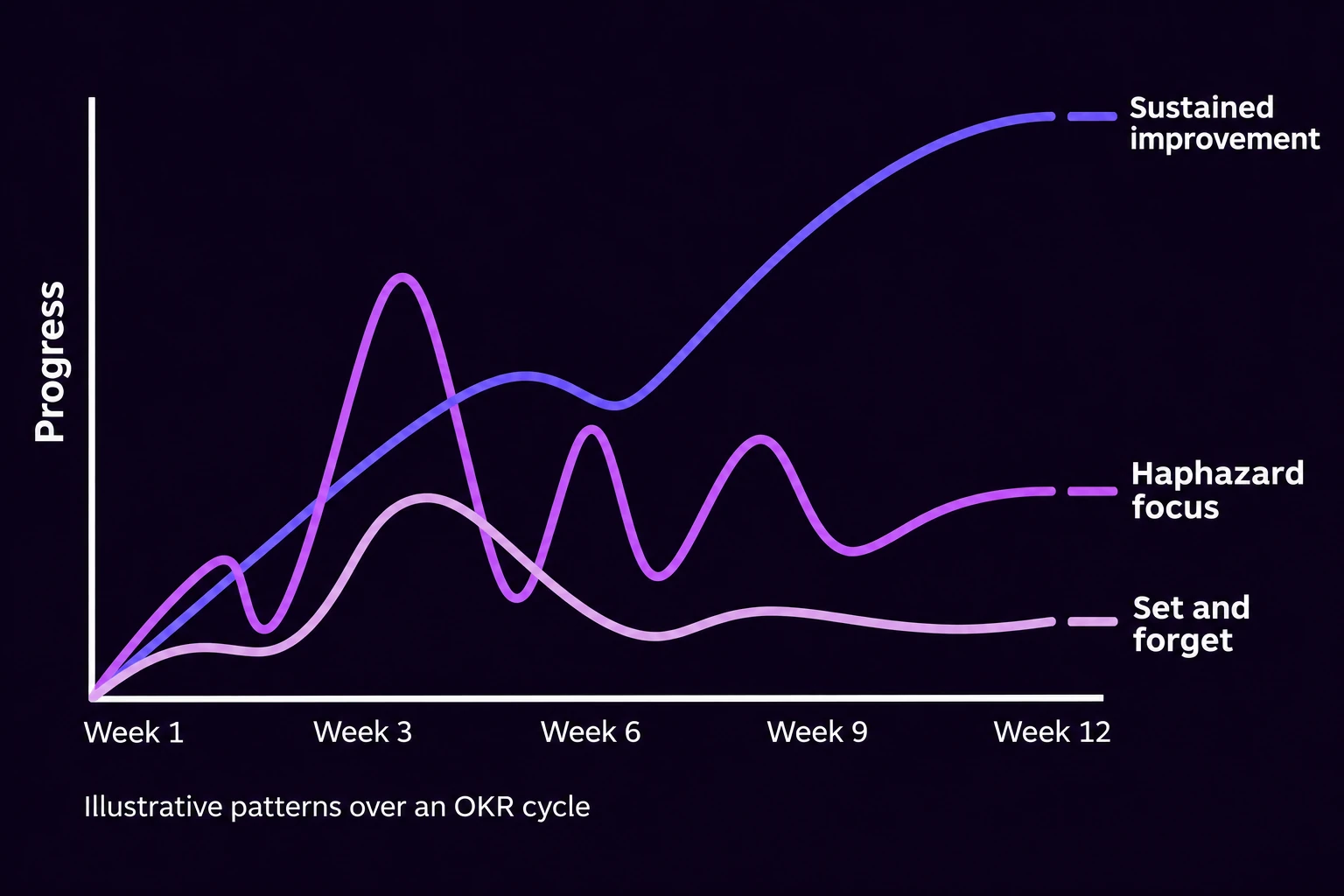
Make checking progress a regular habit. A short weekly update can keep key results in view and expose risks early. Discuss what is changing and decide whether to continue, change the approach or ask for help.
Inspect your OKRs periodically to ensure you’re still doing the right things and making the progress you expect. Keep the data up to date and be honest about progress.
For the larger quarterly review, you have a couple of options. Keep it simple with a yes/no score for each key result and roll that up to the objective, or use a scale from 0.0 to 1.0.
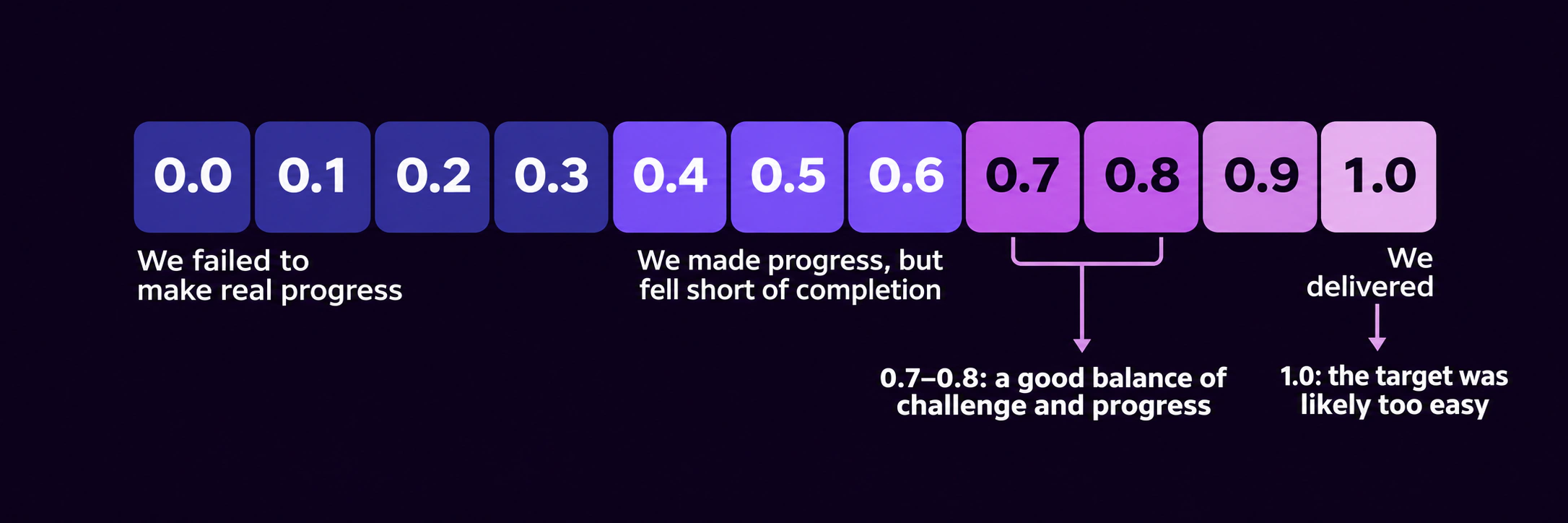
For stretch OKRs, around 0.7 to 0.8 can be a healthy balance between challenge and progress. Consistently scoring 1.0 may mean the targets were too easy. Scores of 0.0 to 0.3 should prompt questions about whether intent and reality are closely aligned.
Use the score to understand what happened and what to change, rather than treating it as a rating of the people doing the work. Read more about grading OKRs.
Score each key result using the method you agreed when setting it. Where the key results carry equal weight, you can average their scores to create an overall score for the objective.
For example, three key results scored at 0.8, 1.0 and 0.6 give:
(0.8 + 1.0 + 0.6) / 3 = 0.8
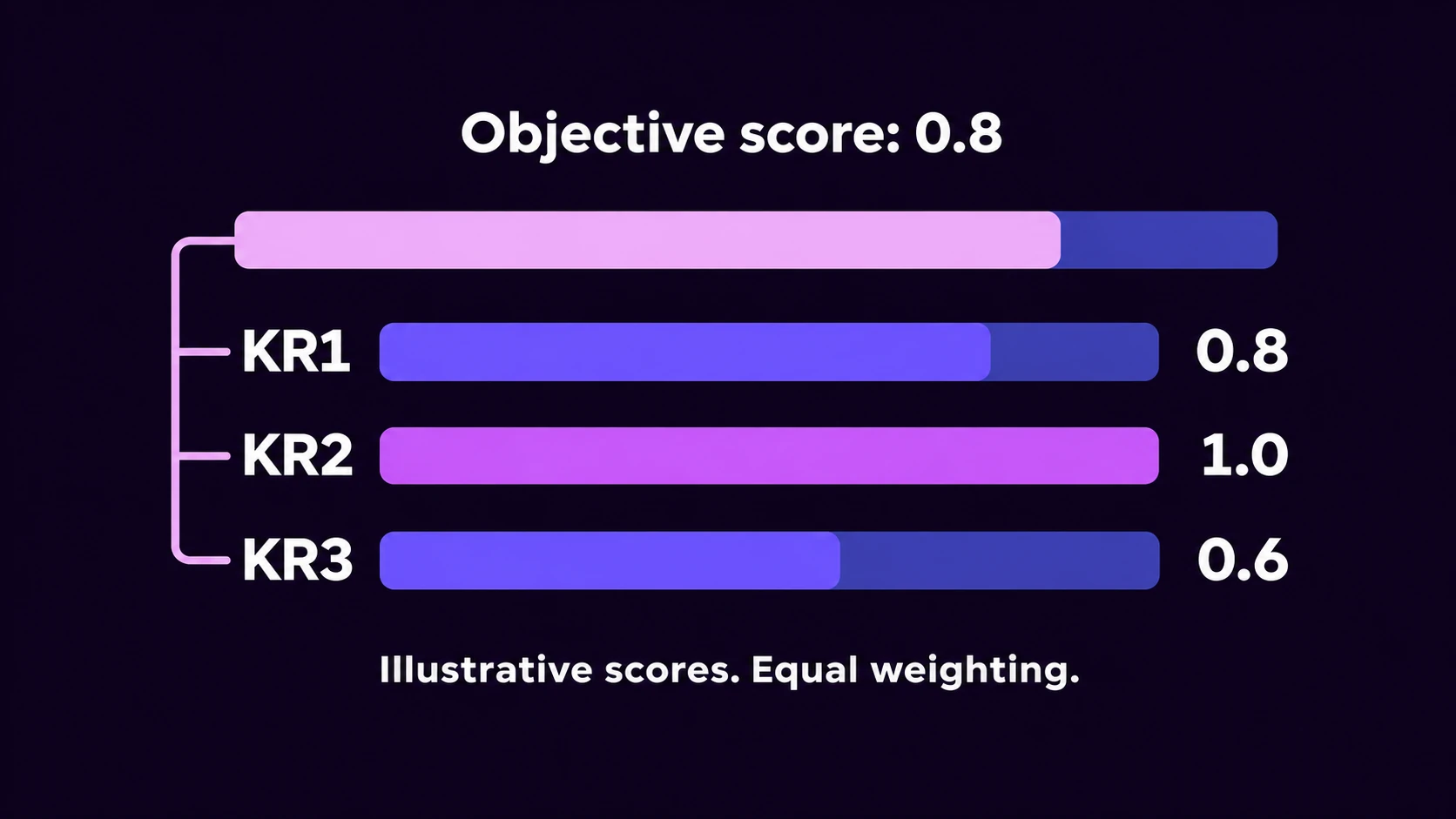
Keep the individual scores visible. An overall 0.8 still includes a key result at 0.6, and an average can conceal a critical result that was missed. Discuss what each result tells you about the objective.
If the key results carry different weights, agree those weights in advance and use a weighted average. Google’s OKR guide explains this approach to grading.
If you're a Scrum team, incorporate monthly or quarterly OKR reviews into a Sprint Review where that fits. Allow time for a couple of extra sessions at the start, especially when formulating your OKRs.
Yes, you can have squad-level OKRs. Their real power is transparency: if teams work with them together, they can see how their efforts connect and gain more benefit.
Yes. OKRs complement both. They tend to cover a much shorter period than a vision, and their measurable key results make progress more tangible.
There are many alternatives that share principles with OKRs. One example is Spotify Rhythm, described by Henrik Kniberg in 2016. It maps key bets back to the company’s beliefs and direction, helping connect work at the coalface to strategic intent.
Read how our work at Funding Circle used OKRs and coaching to strengthen strategic alignment, improve team engagement and support more confident, experimental teams. Want to connect your teams’ work with your strategy? Contact us to discuss introducing OKRs or improving how you use them.
Try the quiz below to check your understanding and see which principles to revisit.
Objective: Build the understanding to try OKRs with your team.
By the end of this attempt, aim to achieve these Key Results:
Correctly assess every statement about meaningful results and scoring.
Correctly assess every statement about starting with OKRs, aligning teams, reviewing progress and prioritising work.
Choose True or False for each statement. Aim for 1.00 in each KR, then use the feedback to decide what to try or revisit.
You can also open the quiz on its own page.
Recognised by
We are proud to be accredited by leading industry bodies