
5 Scientific Rules for Making and Breaking Habits
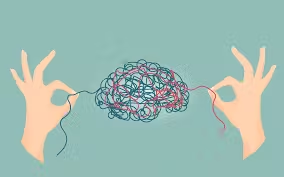
We are what we repeatedly do, making and breaking habits are crucial to taking control and achieving our goals. We frequently need to grow and evolve as we encounter different challenges in our personal and professional lives - but it’s easier said than done.
Most people give up their New Years resolutions within a month and only 9% successful at the end of the year… BUT resolutions are not pointless, studies reveal that resolution-makers are ultimately 10x more successful in changing behaviour than those who do not set a formal resolution. Intention setting is crucial in achieving goals.
A habit ultimately is a neurologically formed pathway in your brain which submits conscious actions to the sub-conscious over time to allow the individual to think about the immediate challenges. Driving is a great example, at first you were very conscious when learning but after years of experience much of driving requires very little thinking allowing you to focus more on your environmental awareness in order to avoid accidents.
To help you break toxic cycles and form beneficial habits, Steven Bartlett of A Diary of a CEO, Dragon’s Den, Forbes 30 under 30 (2020), and serial-entrepreneur, looks through the latest scientific literature to produce a number of rules for resolution and goal setting:
1. Stress is Your Puppet-Master
When we’re in a stressful state we’re more likely to seek out quick dopamine fixes to make us feel good; meaning we’re more likely to make poor decisions and revert back to the behaviour we’re trying to overcome. Studies show that the ability and will to delay gratification is strongly correlated with success - less obesity, higher exam scores, lower levels of substance abuse, better social skills, and generally better levels of success. Focus on the basics, better sleep, exercise, get outdoors, declutter and simplify.
Many habits involve dopamine, the brains feel-good chemical, integrated with neurological pathways and the system responsible for action which is the route of most bad habit. Most of the typical temptations of today, alcohol, drugs, highly-processed foods, refined sugars, pornography (to name a few) have only been around for a tiny fraction of our evolution and therefore our brains are simply not well equipped to deal with stimulates of modernity.
Studies show that you are more likely to do the thing you don’t want to do when you’re stressed out - i.e. you’re more likely to go in search of these feel good chemicals when you’re stressed. Therefore the best thing you can do to avoid these temptations, especially in the crucial early stages of habit forming, is to keep your stress levels low.
2. Know Your Cues / Triggers
Habits have three main parts of what’s referred to as the Habit Loop - Cue, Routine and Reward. Cues are the environmental triggers which start a routine, and our lives are filled with 1000s of cues, which triggers routines to get us that reward so being conscious of what is driving our behaviours (especially the unwanted ones) is key to changing our behaviour.
So perhaps it’s:
- Avoiding the pub to cut down on boozing
- Replacing the “treat cupboard” with something healthier
- Preparing your gym gear and putting your shoes near the door to minimise the effort when you’re about to go to the gym
- Deleting those fast-food apps to avoid notifications
We are more likely to regress to the unwanted behaviours in the context of when you usually perform that routine - if you’re trying to reduce alcohol consumption something like a bar may not be the best environment.
3. Don’t Focus on Stopping Bad Habits, Focus on Replacing Them
You end up doing the thing you’re focusing on - don’t focus on stopping smoking - focus on the behaviour you want to replace it with.
It is impossibly difficult to STOP a bad habit, the science suggests trying to supress these thoughts and habits the more likely you are to rebound and revert back to the undesired habit - chocolate anyone? Don’t rollback, instead, roll forward. Anyone that’s taken up snowboarding will know that the board will go where your eyes are looking, similarly if we’re focused on NOT having a cigarette, that leads to stress and increase the likelihood of regression, but if you replace the packet with a packet of lollipops or chewing gum without changing the cue or fundamental routine, you’re far more likely to succeed.
Building new habits takes time, if you fall off the wagon, simply hop back on.
4. Have a Better Reason to Quit
Neuroscience has shown even if you “replace” an undesirable habit with a better one, the original habit will provide a much stronger dopamine reward. Habits are never truly gone, they are only superseded which we can regress to when we’re stressed. We’ve all been there trying to get “beach ready” but the minute summer is over we revert back to our original habits - because it’s a shallow and temporary goal. Having a more intrinsic motivation can help curb and convince us that of the importance of avoiding that superior dopamine hit.
Health, fitness and wellbeing, for example, is actually the fundamental foundation of your life, without that nothing else is possible - not your career, not quality-time with your family, not your goals. You can get rid of your career and everything else remains, you can abandon a goal and you still have your family, but without your health, fitness and wellbeing, nothing else is possible.
“Change happens when the pain of staying the same becomes greater than the pain of making the change”
That is why loss, whether it be health, family, friends, whatever it might be leads to the greatest chances of change, but we cannot wait for tragedy - get a better reason to change.
5. Willpower is Not Enough
Willpower is an important indicator for individual success, but contrary to popular opinion it is not a skill. It is a limited resource that never remains constant throughout the day, nor the week. Willpower is more like a muscle, and just like those in your arms, legs and throughout your body, the more you exert, the more it fatigues; each time you practice restraint your willpower depletes as it works harder leading to increased stress.
So how do we minimise the demand on our willpower?
By making sure we don’t set too many goals, make sure our aren’t unachievable and make sure our goals aren’t too big. Any goals which feature deprivation, restriction, strain and pressure are more likely to lead to rebound and relapse - unsustainable crash diets are a great example.
Instead break goals down, focus on one or two, small, achievable steps and find ways to rewards yourself with new, healthier and less addictive rewards every single day.
Bonus: Pose a Question
The ‘Question Behaviour Effect’ is where you ask yourself or another about performing a certain behaviour drastically influences whether they do it in the future or not and this effect has been shown to last up to 6 months after asking the question.
Instead of saying “I’m going to the gym”, or “I want to go to the gym” ask yourself or someone else “are you going to go to the gym?”.
Cognitive dissonance will question the current reality and behaviours against the image of ourselves (who we want to be) that we hold in our heads and cause enough discomfort to commit to the path we know we should take. Ask a question which encourages a definitive yes or no answer - they do not offer a way to wiggle out of it, explain it away, and has no room for clarification or excuses.
Another great reminder of the power of coaches, mentors, therapists, family and friends - it’s a great idea to talk about this with others.
Final Thoughts
Remember, we all have peaks and troughs. We fall off the wagon. We’ll end up in the sweet drawer now and again. Sometimes we’re motivated, sometimes we’re not. None of us are perfect, we’re all human, but try to fail forward.
… but the big question is: are you going to make meaningful positive change? Yes or no?